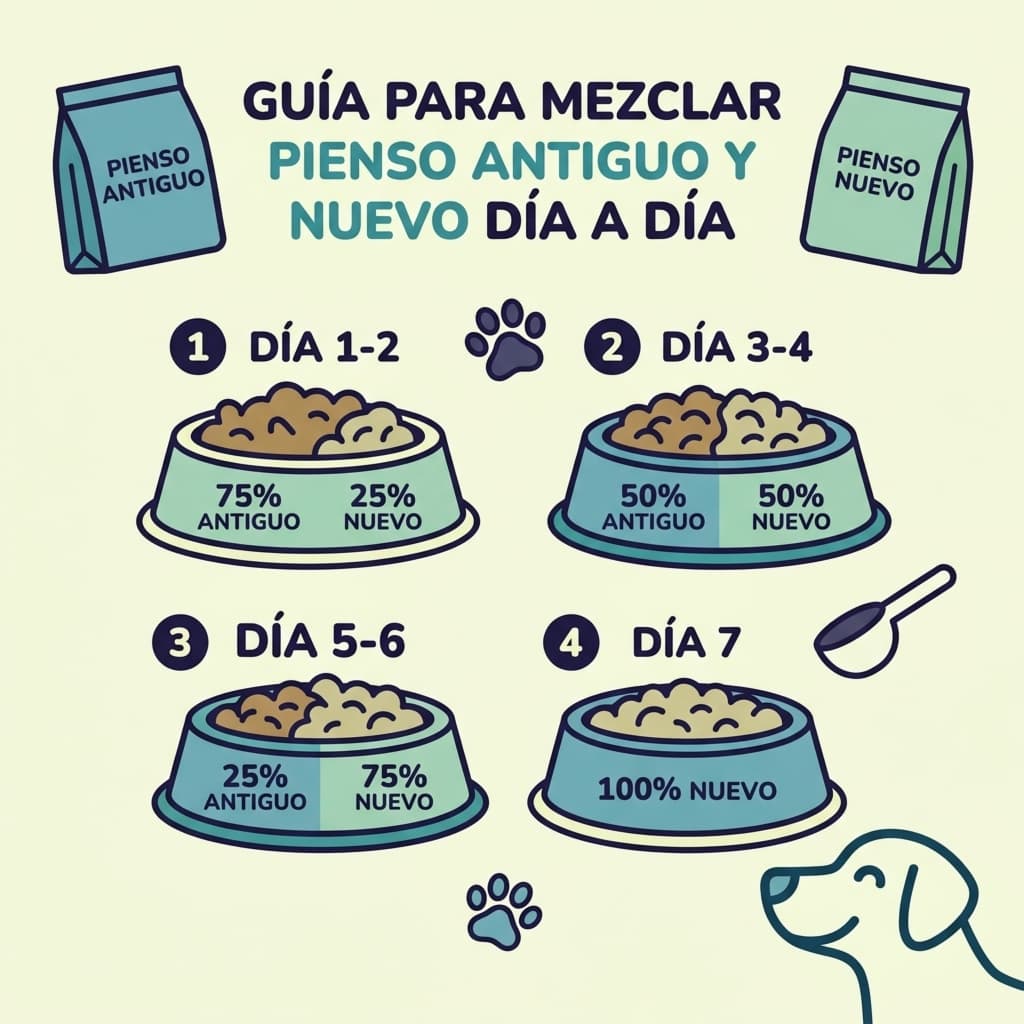
Day-by-Day Guide to Mixing Old and New Dog Food
When you change your dog's food, the safest approach is usually not replacing one food with another overnight. It is better to mix the old and new food over several days, gradually increasing the amount of the new food.
This gives the digestive system time to adjust and lowers the risk of loose stool, gas, vomiting, or diarrhea. It also helps you notice early if the new food does not agree with your dog.
In this guide, you'll find a simple daily schedule, examples in grams, and tips for adjusting the pace based on your dog's response.
Daily dog food mixing schedule
For a healthy adult dog, this 7-day schedule is a useful starting point:
| Day | Old food | New food |
|---|---|---|
| 1 | 75% | 25% |
| 2 | 75% | 25% |
| 3 | 50% | 50% |
| 4 | 50% | 50% |
| 5 | 25% | 75% |
| 6 | 25% | 75% |
| 7 | 0% | 100% |
If your dog has a sensitive stomach, has had diarrhea during previous food changes, or is eating a veterinary diet, use a slower 10-to-14-day transition and ask your vet for advice if there is a medical condition involved.
How to calculate the mix in grams
Percentages are useful, but day to day you need to convert them into grams.
Imagine your dog eats 200 grams of food per day. The mix would look like this:
| Day | Old food | New food | Daily total |
|---|---|---|---|
| 1 | 150 g | 50 g | 200 g |
| 2 | 150 g | 50 g | 200 g |
| 3 | 100 g | 100 g | 200 g |
| 4 | 100 g | 100 g | 200 g |
| 5 | 50 g | 150 g | 200 g |
| 6 | 50 g | 150 g | 200 g |
| 7 | 0 g | 200 g | 200 g |
If your dog eats twice a day, split each amount between the two meals. For example, on day 1 that would be 75 g of old food and 25 g of new food per meal.
Watch out: the new food may have different calories
You should not always keep exactly the same number of grams when switching foods. Two kibbles can look similar but have different calorie densities.
Before starting, check the feeding guide on the new food package. If the new food recommends a different daily amount, make the transition using the final ration that fits that food and your dog's weight.
If you're unsure, use the manufacturer's guide as a starting point and adjust based on your dog's weight, body condition, appetite, and stool quality.
A slower transition for sensitive dogs
Some dogs need more time. In that case, you can use this schedule:
| Days | Old food | New food |
|---|---|---|
| 1 to 3 | 80% | 20% |
| 4 to 6 | 60% | 40% |
| 7 to 9 | 40% | 60% |
| 10 to 12 | 20% | 80% |
| Day 13 onward | 0% | 100% |
This slower version can be especially helpful if your dog often has loose stool, is older, has had digestive issues, or the change between foods is significant, such as moving from a low-fat food to a more energy-dense one.
What to watch each day
While mixing both foods, pay attention to three things:
- Stool: it should stay formed or, at most, become slightly softer for a day or two.
- Appetite: your dog should keep eating normally.
- Energy: your dog should not seem lethargic, painful, or unusually quiet.
Mild gas can happen at first, but it should not be severe or come with diarrhea, vomiting, or obvious discomfort.
What to do if stool gets soft
If the stool becomes a little soft but your dog is bright and eating well, do not move to the next percentage yet.
The safest approach is to:
- Keep the current mix for 2 or 3 more days.
- Go back to the previous step if the stool does not improve.
- Remove treats, table scraps, and extras while things settle.
- Restart with smaller increases.
For example, if 50% new food is too much, go back to 25% for a few days and then try 35% or 40% before reaching 50% again.
When to stop the transition and call the vet
Pause the switch and contact your vet if you notice:
- Watery or repeated diarrhea.
- Blood in the stool.
- Vomiting.
- Loss of appetite.
- Lethargy or abdominal pain.
- Signs of dehydration.
- Diarrhea lasting more than 24 to 48 hours.
It is also wise to ask for advice before switching food if your dog is a puppy, senior, has digestive, kidney, liver, or pancreatic disease, or is eating a vet-prescribed diet.
Common mistakes when mixing dog foods
Starting when there is very little old food left
If you only have enough old food for one or two days, you will not have enough time for a proper transition. It is better to buy the new bag before the old one runs out.
Mixing without measuring
Guessing can easily create an oversized ration. Weigh the food, especially if your dog is small or needs weight control.
Changing treats and wet food too
During the transition, keep everything else the same. If you add new treats at the same time, it will be harder to know whether the problem comes from the food or the extras.
Forcing the schedule when your dog is not tolerating it
The table is a guide, not a rule. If your dog needs more days, give them more days.
In summary
To mix old and new dog food day by day:
- Start with 75% old food and 25% new food.
- Increase the new food every two days if stool stays normal.
- Measure the total daily ration in grams.
- Use a slower transition if your dog is sensitive.
- Do not add other new foods during the switch.
- Call your vet if diarrhea is severe, bloody, comes with vomiting, or your dog seems unwell.
A well-managed food change does not need to be complicated. With a scale, a simple schedule, and a few days of patience, you can help your dog adapt much more comfortably.
Sources consulted
- WSAVA Global Nutrition Committee. Nutrition toolkit and pet food selection guidelines.
- VCA Animal Hospitals. Dietary transition and feeding recommendations for dogs.
- Merck Veterinary Manual. Diarrhea in small animals.